When Does Tax Efficiency Become Tax Avoidance? The Hinduja Demerger and the (Over) Reach of GAAR


India’s General Anti-Avoidance Rules (“GAAR”) were conceived as an exceptional anti-abuse measure intended to operate as a backstop against contrived arrangements that, though legally compliant in form, are predominantly tax-driven and lack commercial substance. In practice, however, GAAR is increasingly being invoked in corporate restructurings[1]See “Delhi HC to examine GAAR triggered dividend-tax rate dispute in Vedanta-India’s delisting structure”, Taxutra, (available at link, last accessed on December 23, 2025). where tax efficiencies co-exist with genuine commercial and organizational objectives.
The dispute arising from the Hinduja Group demerger[2]Hinduja Global Solutions Limited v. PCIT, Mumbai & Ors., Bombay High Court (Writ Petition No. 4867/2025). marks an important development in India’s evolving GAAR jurisprudence. The demerger has been questioned under GAAR on the premise that it was undertaken primarily to obtain tax benefits. This has revived fundamental jurisprudential issues on whether GAAR can be invoked to re-characterise a transaction undertaken in conformity with the provisions of the Income-tax Act, 1961 (“ITA”) for tax neutrality, and whether the presence of a significant tax benefit undermines the relevance of an otherwise demonstrable commercial rationale of the transaction.
Background: The Hinduja Group Demerger
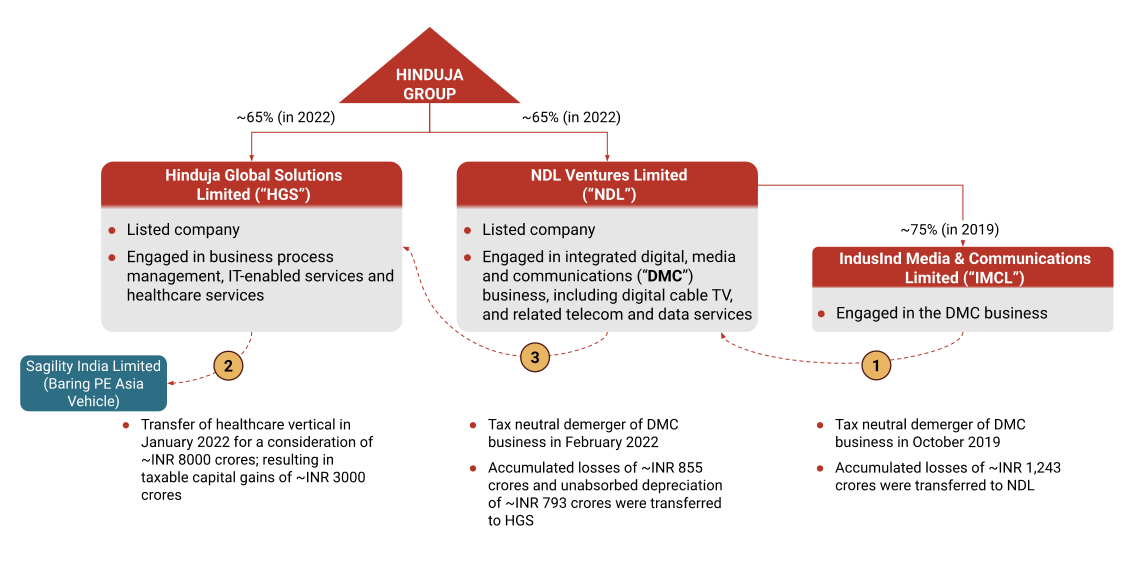
Step 1: IMCL–NDL Demerger (October 2019)
The DMC vertical of IMCL was demerged into Hinduja Ventures Limited (subsequently renamed NDL) with effect from October 01, 2019.[3]C.P. (CAA) No. 940/MB/2020.
This demerger was implemented as a tax-neutral transaction and the demerged undertaking’s accumulated business losses and unabsorbed depreciation of approx. INR 1,243 crores were transferred to NDL in terms of Section 72A(4) of the ITA.[4]The relevant statutory provisions have been discussed below in Section 3.2 of this Note.
Step 2: Sale of Healthcare Business by HGS (January 2022)
In January 2022, HGS divested its healthcare services vertical through a slump sale to Sagility India Limited (a Baring PE Asia vehicle) for approx. INR 8,000 crores. This resulted in taxable capital gains of approx. INR 3,000 crores in the hands of HGS in the financial year (“FY”) 2021-2022.[5]“10 Key Findings of GAAR Panel Order characterising Hinduja Group de-merger as impermissible avoidance arrangement”, Taxsutra, (available at link, last accessed on December 23, 2025).
Step 3: NDL–HGS Demerger (February 2022)
Within a month of the healthcare divestment, NDL’s DMC undertaking was demerged into HGS with effect from February 01, 2022, pursuant to a scheme sanctioned by the National Company Law Tribunal, Mumbai (“NCLT”) on November 11, 2022.[6]C.P. (CAA) No. 173/MB/2022.
This demerger was also implemented as a tax-neutral transaction and the demerged undertaking’s accumulated business losses and unabsorbed depreciation of approx. INR 1,648 crores were transferred to HGS in terms of Section 72A(4) of the ITA.[7]The relevant statutory provisions have been discussed below in Section 3.2 of this Note.
Tax Outcome
Following the NDL–HGS demerger, HGS set-off approx. INR 1,200 crores of accumulated losses and unabsorbed depreciation pertaining to NDL’s demerged undertaking against HGS’s income for the FYs 2021-2022 and 2022-2023, including capital gains from the divestment of its healthcare business.[8]Supra note 5.
Statutory Framework: GAAR and Tax-Neutral Demergers
GAAR Provisions
Section 95 of the ITA empowers the tax authorities to treat an arrangement as an impermissible avoidance arrangement (“IAA”) and determine its tax consequences in accordance with Chapter X-A of the ITA.
An arrangement qualifies as an IAA in terms of Section 96(1) of the ITA where its main purpose is to obtain a tax benefit and it satisfies at least one of the four specified tainted elements: (i) creates rights or obligations that are not at arm’s length, (ii) results in misuse or abuse of the provisions of the ITA, (iii) lacks commercial substance, or (iv) is not for bona fide purposes.
Section 97 of the ITA further delineates when an arrangement is deemed to lack commercial substance and, inter alia, treats arrangements involving an “accommodating party” as lacking such substance. An “accommodating party” in terms of Section 97(3) of the ITA is one whose main purpose of participating in an arrangement is to secure a tax benefit for the relevant taxpayer.
Tax-Neutral Demerger and Loss-Transfer Provisions
Under the ITA, demergers that meet the conditions in Section 2(19AA) of the ITA are accorded tax-neutral treatment. In such cases:
- The transfer of capital assets from the demerged company to the resulting Indian company is exempt from capital gains tax in terms of Section 47(vib) of the ITA; and
- The accumulated business losses and unabsorbed depreciation of the demerged undertaking are allowed to carry over to the resulting company in terms of Section 72A(4) of the ITA.
GAAR Reference and Panel’s Directions in Hinduja Group Demerger
Pursuant to search and survey proceedings conducted against the Hinduja Group in late 2023, a reference was made to the GAAR Panel. The reference concerned HGS’s claim to set off the accumulated business losses and unabsorbed depreciation pertaining to NDL’s demerged undertaking against HGS’s income for the FYs 2021-2022 and 2022- 2023 (including capital gains from the sale of the healthcare division).
The GAAR Panel issued its directions on October 30, 2025, characterising the NDL–HGS demerger as an IAA, and disallowing the carry forward and set-off of the transferred losses and depreciation in the hands of HGS.
Key Findings of the GAAR Panel
Application of the “Main Purpose” Test
The GAAR Panel held that the main purpose of the NDL–HGS demerger was to obtain a tax benefit for HGS. While acknowledging that mergers and demergers may pursue multiple commercial objectives, the Panel concluded that the dominant purpose of the NDL–HGS demerger was to set-off the demerged undertaking’s losses and depreciation against HGS’s income, relying inter alia on the magnitude of the resulting tax benefit.
Lack of Commercial Substance / “Accommodating Party”
With the “main purpose” threshold regarded as met, the GAAR Panel held that the NDL– HGS demerger lacked commercial substance in terms of Section 96(1)(c) of the ITA, characterising NDL as an “accommodating party”. The Panel viewed NDL’s role as limited to facilitating the transfer and utilisation of its accumulated losses and depreciation pool to reduce HGS’s capital gains.
Treatment of NCLT Sanction
On the relevance of the NCLT’s sanction, the GAAR Panel observed that the NCLT’s jurisdiction is confined primarily to company law matters and does not extend to issues of tax-avoidance or GAAR. The Panel therefore held that the NCLT approval of the scheme does not preclude the invocation of GAAR.
Bombay High Court’s Stay Order
Following the GAAR reference and the GAAR Panel’s directions, HGS filed a writ petition before the Bombay High Court challenging the invocation of GAAR in respect of the NDL–HGS demerger.
Considering the absence of any statutory appellate remedy against the Panel’s directions, the Court admitted the petition and, by its order dated 19 December 2025,[9]Supra note 2. stayed: (i) the GAAR reference; (ii) the GAAR Panel’s directions; and (iii) the consequential assessment proceedings for the FYs 2021-2022 and 2022-2023.
Prima facie, the Bombay High Court noted two significant aspects:
- The NDL–HGS demerger had been sanctioned by the NCLT after notice to the tax authorities; and
- Section 72A(4) of the ITA expressly permits carry forward of losses in qualifying demergers.
While the merits of the dispute remain open for final adjudication, the stay order reflects judicial discomfort with the GAAR Panel’s approach.
Key Legal Issues Arising from the Dispute
Against this factual and procedural backdrop, this dispute raises a set of key legal issues on the scope, thresholds, and limits of GAAR that merit closer examination.
GAAR and NCLT-Sanctioned Schemes
A central question in this dispute is the extent to which GAAR may be invoked to re‑characterise transactions forming part of an NCLT‑sanctioned scheme of arrangement or demerger, where the tax authorities had prior notice of the scheme. The Supreme Court in Dalmia Power Ltd v. ACIT[10][2020] 420 ITR 339 (SC). recognized that a sanctioned scheme attains statutory force and operates in rem, binding not only the parties but also statutory authorities that were put to notice—a principle consistently affirmed by the income-tax appellate tribunals.[11]ITO, Kolkata v. Purbanchal Power Co. Ltd., (2014) SCC OnLine ITAT 4916; Indus Towers Ltd v. DCIT, New Delhi, 2024 SCC OnLine ITAT 4597; KIFS International LLP v. ACIT, Ahmedabad, ITA No. … Continue reading
The Central Board of Direct Taxes (“CBDT”) similarly acknowledged that the tax authorities’ opportunity to examine and object to the purpose or design of a scheme arises at the approval stage before the competent authority.12 Reflecting this approach, the ITAT in Urmin Marketing held that objections to a scheme must be raised before the approving authority and cannot later be re-agitated in assessment proceedings.[12]Urmin Marketing (P.) Ltd. v. DCIT, Ahmedabad, [2020] 122 taxmann.com 40.
The Chandigarh Bench of the NCLT in Panasonic India[13]CP (CAA) No.8/Chd/Hry/2021. underscores this distinction. There, the tax department objected at the approval stage, challenging the commercial rationale of the scheme. The NCLT considered these objections but nevertheless sanctioned the scheme, clarifying that only routine tax consequences could be examined at the assessment stage. Notably, the Shome Committee[14]The Shome Committee, formally constituted by the Government of India in 2012 under the chairmanship of Dr. Parthasarathi Shome, was an expert committee mandated to review and recommend the framework … Continue reading, when examining the scope of GAAR, also recommended that court‑approved amalgamations and demergers should ordinarily fall outside its ambit.
Thus, the jurisprudence and administrative guidance point to a coherent framework: while the NCLT sanction may not, by itself, place a transaction beyond the reach of GAAR, GAAR is equally not intended to permit examination of commercial rationale or foundational objectives of a scheme where the tax authorities had the opportunity to raise such objections before the approving authority.
Commercial Substance and Statutory Carry forward of Losses
The GAAR Panel’s directions raise a broader question on how “commercial substance” should be assessed where the statute expressly permits carry forward of losses to resulting entities in qualifying demergers. Corporate demergers often involve the separation or recombination of profitable and loss-making businesses, and the coexistence of taxable gains in one entity and losses in another is not indicative of a lack of commercial substance.
Unlike amalgamations, where carry forward of losses under Section 72A(1) of the ITA was initially permitted only in limited and specifically identified cases (involving industrial undertakings or ships) and expanded gradually through subsequent amendments, Section 72A(4) of the ITA allows loss migration in demergers as a general rule. Such distinction suggests a conscious legislative choice to facilitate carry forward of losses in demergers without imposing additional preconditions.
Where the Parliament had not imposed fetters on the carry forward of losses in qualifying demergers, whether the GAAR provisions can be invoked to deny such outcomes? Comparative jurisprudence cautions against such an approach. The Supreme Court of Canada[15]Queen v. Alta Energy, 2021 SCC 49. has characterised GAAR as an interpretative tool, requiring courts to first ascertain the object, spirit and purpose of the relevant tax provisions before determining whether an arrangement defeats those objectives.
Main Purpose v. “Tainted Element”
Section 96(1) of the ITA is structured as a two-step inquiry: first, the arrangement must have the “main purpose” of obtaining a tax benefit; and second, it must satisfy at least one of the four specified tainted elements. A key issue arising from the Hinduja dispute is whether the GAAR Panel’s reasoning allows the existence and quantum of a tax benefit to simultaneously establish the “main purpose” and infer the presence of a tainted element.
If a substantial tax benefit, combined with group control and a loss-making undertaking, is treated as sufficient to meet both limbs by characterising a party (NDL, in this case) as an “accommodating party”, the statutory distinction between the two limbs of Section 96(1) of the ITA is effectively eroded. Such an approach risks converting GAAR from a targeted anti-abuse rule into a results-based test, contrary to the legislative design of Chapter X-A of the ITA.
“Accommodating Party” in a Bilateral Demerger
The notion of an “accommodating party” is typically invoked in multi-party arrangements involving conduit entities with limited or peripheral commercial roles. Its application in a bilateral statutory demerger, however, raises conceptual difficulties.
If NDL is both the demerged company and an accommodating party whose participation may be disregarded under Section 99 of the ITA, it becomes unclear what remains of the arrangement for GAAR analysis. This issue ultimately calls into question the conceptual soundness of applying the “accommodating party” test in bilateral merger and demerger structures, and suggests that its use in such a context risks overstretching the GAAR framework.
The Way Forward
The Hinduja Group demerger dispute is more than a controversy over set-off of losses; it represents an important development in the evolution of India’s GAAR jurisprudence. It squarely raises the question whether GAAR is to remain an exceptional anti-abuse measure, confined to demonstrably contrived arrangements, or whether it will be used more routinely to revisit tax-efficient restructurings that comply with the statutory framework.
The outcome of the Hinduja dispute will therefore have implications beyond the parties. It will influence how taxpayers design group reorganisations, how the tax authorities frame GAAR references, and how courts draw the line between legitimate tax planning and impermissible avoidance. The credibility of India’s GAAR regime will ultimately turn on its use as a calibrated exception, grounded in statutory purpose and commercial reality, rather than as a broad tool to unsettle transactions that the law itself accommodates.
Footnotes
| ↑1 | See “Delhi HC to examine GAAR triggered dividend-tax rate dispute in Vedanta-India’s delisting structure”, Taxutra, (available at link, last accessed on December 23, 2025). |
|---|---|
| ↑2 | Hinduja Global Solutions Limited v. PCIT, Mumbai & Ors., Bombay High Court (Writ Petition No. 4867/2025). |
| ↑3 | C.P. (CAA) No. 940/MB/2020. |
| ↑4 | The relevant statutory provisions have been discussed below in Section 3.2 of this Note. |
| ↑5 | “10 Key Findings of GAAR Panel Order characterising Hinduja Group de-merger as impermissible avoidance arrangement”, Taxsutra, (available at link, last accessed on December 23, 2025). |
| ↑6 | C.P. (CAA) No. 173/MB/2022. |
| ↑7 | The relevant statutory provisions have been discussed below in Section 3.2 of this Note. |
| ↑8 | Supra note 5. |
| ↑9 | Supra note 2. |
| ↑10 | [2020] 420 ITR 339 (SC). |
| ↑11 | ITO, Kolkata v. Purbanchal Power Co. Ltd., (2014) SCC OnLine ITAT 4916; Indus Towers Ltd v. DCIT, New Delhi, 2024 SCC OnLine ITAT 4597; KIFS International LLP v. ACIT, Ahmedabad, ITA No. 684/Ahd/2023; and Urmin Marketing (P.) Ltd. v. DCIT, Ahmedabad, [2020] 122 taxmann.com 40. |
| ↑12 | Urmin Marketing (P.) Ltd. v. DCIT, Ahmedabad, [2020] 122 taxmann.com 40. |
| ↑13 | CP (CAA) No.8/Chd/Hry/2021. |
| ↑14 | The Shome Committee, formally constituted by the Government of India in 2012 under the chairmanship of Dr. Parthasarathi Shome, was an expert committee mandated to review and recommend the framework for implementation of the GAAR and related tax policy issues. |
| ↑15 | Queen v. Alta Energy, 2021 SCC 49. |